
Simulate Treatment Scenarios. Compare Molecular Responses.
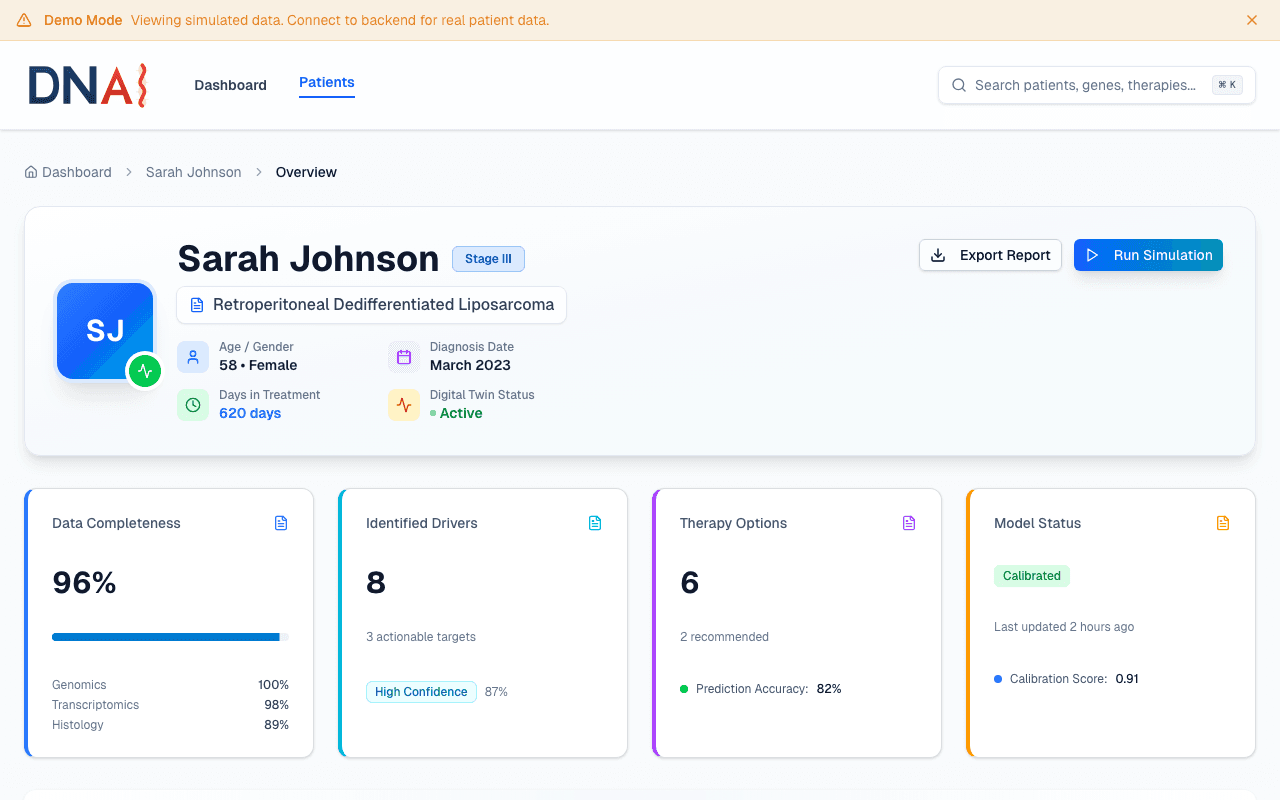
DNAI creates patient-specific digital twins from multi-omics data to simulate therapy outcomes — helping researchers explore treatment scenarios with quantified uncertainty and generate testable hypotheses.
The Virtual Tumor Board
A dedifferentiated liposarcoma patient faces standard-of-care doxorubicin. The researcher needs to explore: would a CDK4/6 inhibitor combination show higher simulated sensitivity?
Molecular Profiling
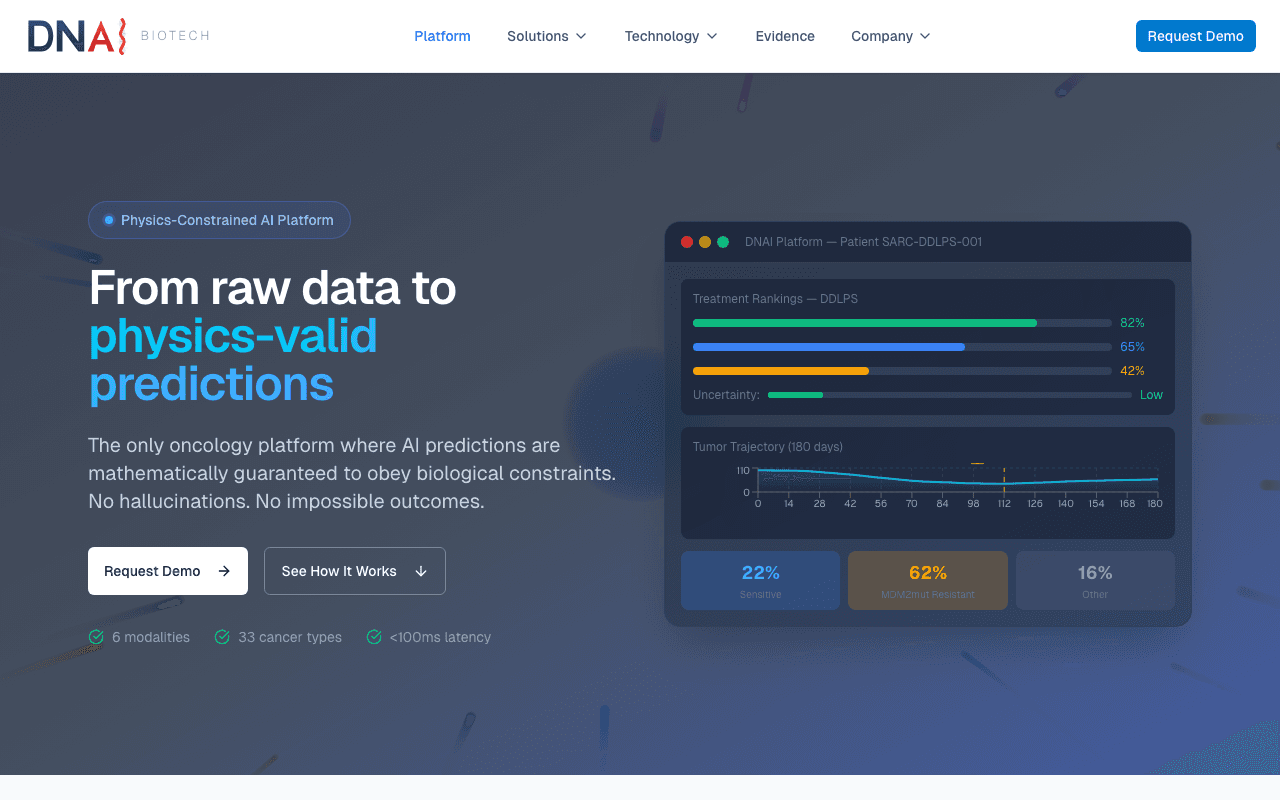
The Simulation
The Research Insight
How DNAI supports clinical research
Simulation-informed insights for treatment planning and research
Rapid simulation
Get simulated treatment outcomes in seconds. Upload multi-omics data and receive immediate response estimates with model uncertainty intervals.
Patient-specific
Each simulation is derived from the individual patient's molecular profile — not population averages.
Uncertainty quantified
Model uncertainty intervals and abstention flags accompany all simulations. The system tells you when not to trust a result.
Research applications
Treatment scenario comparison
Rank treatment options by simulated sensitivity for each patient. Compare targeted therapies, immunotherapy, and combination regimens with model uncertainty intervals.
Survival risk modeling
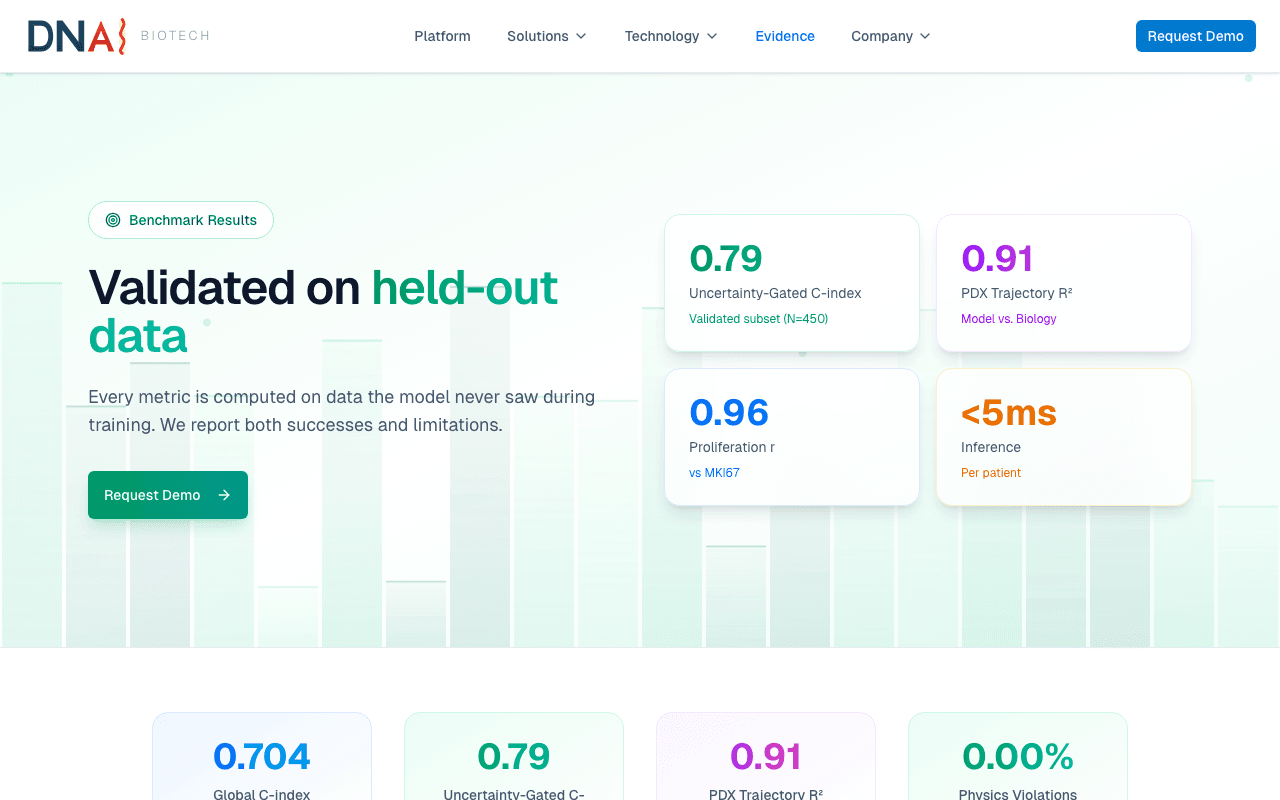
Simulate survival trajectories to explore prognosis hypotheses. Per-horizon calibration at 1yr, 2yr, 3yr, and 5yr (internal validation).
Resistance scenario simulation
Simulate tumor evolution to explore potential resistance emergence patterns and generate hypotheses about adaptive treatment strategies.
See the Clinical Platform
Explore the research tools for patient-specific simulation
Known Limitations
Intended use
DNAI is intended solely as a research tool for hypothesis generation and exploratory molecular analysis. It is not approved, cleared, or validated as a clinical decision support system, diagnostic device, or companion diagnostic. All simulations should be interpreted alongside standard clinical evidence by qualified researchers.
Schedule a research demo
See how DNAI simulation tools can support your oncology research.
Request Demo