
Simulate drug programs before they fail
90% of Phase II failures are translation failures. DNAI's mechanistic simulation platform helps pharma teams translate preclinical data, design smarter trials, and rescue shelved compounds — all in silico.
Three workflows. One simulation platform.
Every pharma program hits the same bottlenecks: translation risk, enrollment guesswork, and shelved assets. DNAI addresses each with validated, mechanistic simulation.
Translational De-risker
“Will this PDX result translate to human?” Physics-constrained domain separation isolates species-specific artifacts from shared tumor biology, giving you a confidence score on every preclinical-to-clinical prediction.
Trial Design Autopilot
“Who should be in my trial?” DRO-validated enrichment biomarkers identify which molecular subgroups are most likely to respond, with site-robust performance across institutions.
Mechanism & Rescue
“Can my failed compound be rescued?” The MechanismOperator maps drug targets across 108 cancer-specific pathways (50 Hallmark + 58 expansion pathways covering immune subprograms, stromal biology, and treatment resistance) and simulates combination strategies to find responsive subgroups.
The Hybrid Engine
Two complementary model paths — data type determines routing
Data-type routing — human clinical data uses Path A; preclinical PDX data uses Path B via DSN.
Every prediction comes with a reliability certificate
Validated across 8 external cohorts (245K+ patients). GREEN tier achieves C=0.744 on unseen data. The platform knows when it doesn't know — and tells you.
Hypothesis generator, not prescription engine.
Every output includes evidence tiers, data sufficiency gates, and structured abstention. We tell you what's worth testing — not what to prescribe.
Prioritizing Drug Candidates Early
Your new compound shrinks tumors in mice. Simulate human-scale outcomes in silico to generate hypotheses for your Go/No-Go decision — before investing in Phase II.
Drug Calibration (DSN Pipeline)
Virtual Trial Simulation
Enterprise-ready deployment
Single-tenant VPC. Your data never leaves your infrastructure. GxP-compliant audit trails with deterministic replay.
R&D applications
Trial enrichment
Simulate which patient subgroups show highest response, informing enrollment criteria and reducing required sample sizes.
Mechanism-Based Enrichment
PATHWAYUse DNAI's pathway-level analysis to find patients with the specific pathway dysregulation your drug targets. Generate mechanism-linked hypotheses — identify which molecular features associate with simulated response. DNA-only Panel Adapter (Mode B) supports 167 gene panels for broader patient coverage.
Combination screening
Predict drug combinations via orthogonal clonal targeting. Validated at ρ=0.800 on 1,209 drug pairs (LTFO ρ=0.689). Explore synergistic pairs and optimal sequencing strategies in silico.
Resistance simulation
Run ensemble simulations of clonal evolution to explore potential resistance mechanisms — with outcome distributions, clone extinction probabilities, and resistance onset timing to inform adaptive treatment protocol design.
Hybrid Control Arms
Generate physics-constrained synthetic patient trajectories for control arms. Modeled potential to reduce control-arm enrollment — enabling more patients to receive experimental treatments.
Dose-Response Optimization
IN SILICODNAI's differentiable engine enables PK/PD-constrained schedule optimization that balances simulated efficacy and safety constraints. Achieves 42% dose reduction vs standard concurrent dosing while maintaining equivalent simulated efficacy.
Virtual Tumor Burden Endpoints
v3.1DNAI simulates longitudinal tumor volume trajectories, enabling estimation of tumor burden changes over time. Volume-to-response classification (CR/PR/SD/PD) serves as an approximation of clinical imaging endpoints.
Platform Capabilities
How each component supports drug development and research
| Feature | Pharma Value (Drug Dev) | Research Value |
|---|---|---|
| DSN (Sim-to-Real) | ESSENTIAL Translate mouse data to human-scale simulations | Background — ensures physics engine uses conserved biology |
| Imputation | ESSENTIAL Use partial preclinical data | Background — handles missing modalities |
| Neural ODE | VIRTUAL TRIAL Simulate patient cohorts for trial design | PROGNOSIS Simulate patient trajectories |
| Safety Layer | QC Flag unreliable PDX models | ABSTENTION Flag when model cannot reliably simulate |
See the Biopharma Platform
Explore the tools for virtual trials, cohort simulation, and mechanism discovery
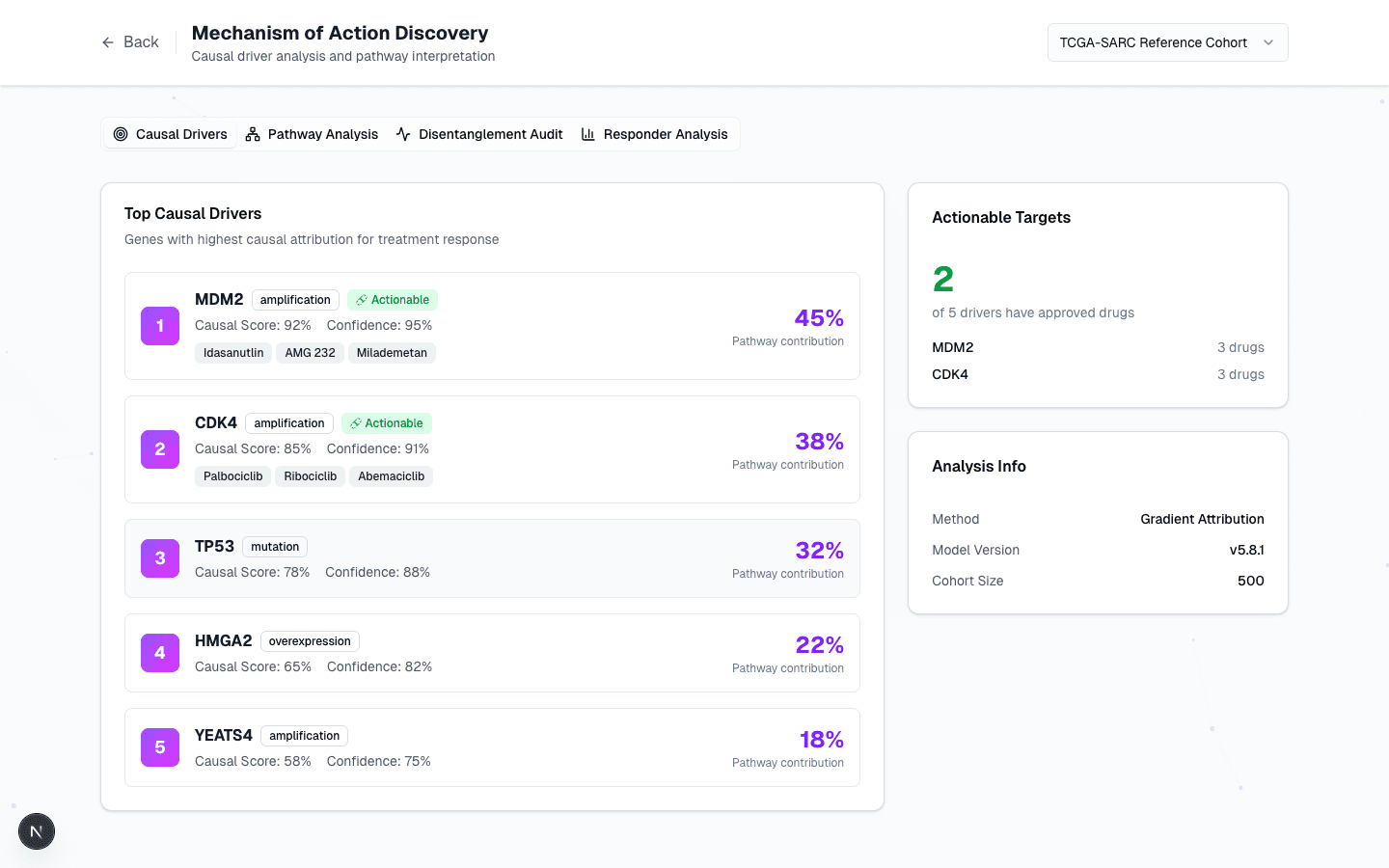
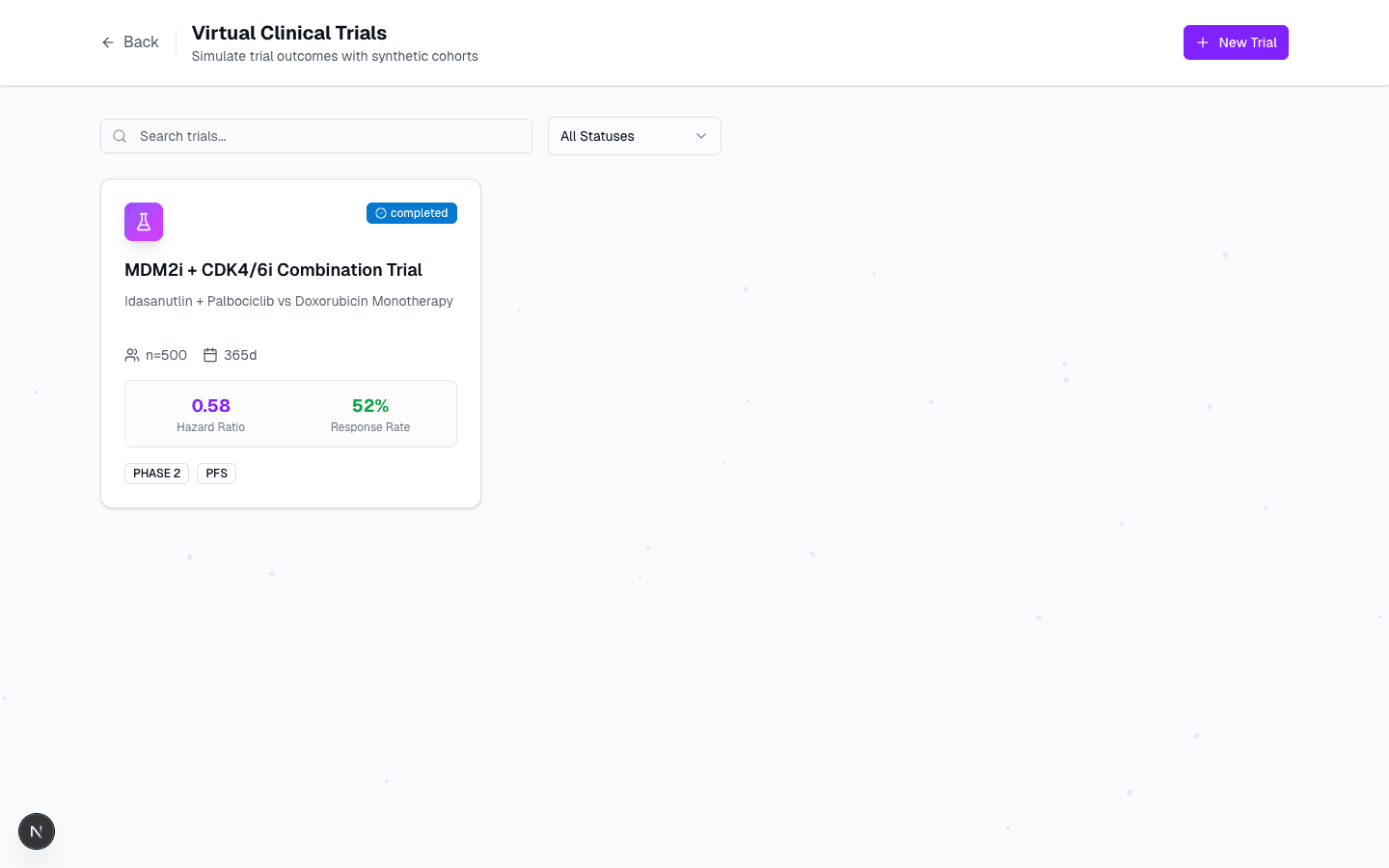
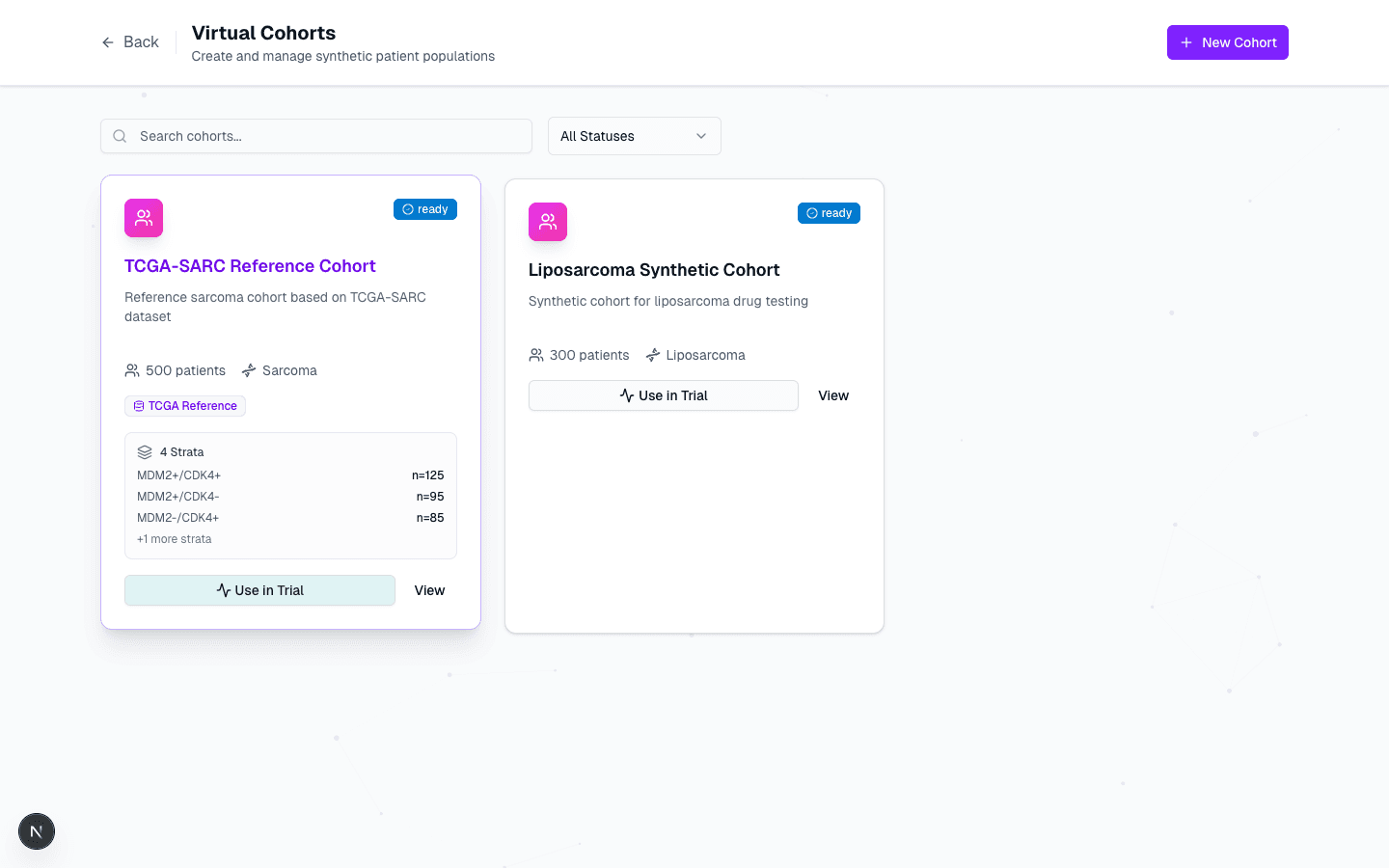
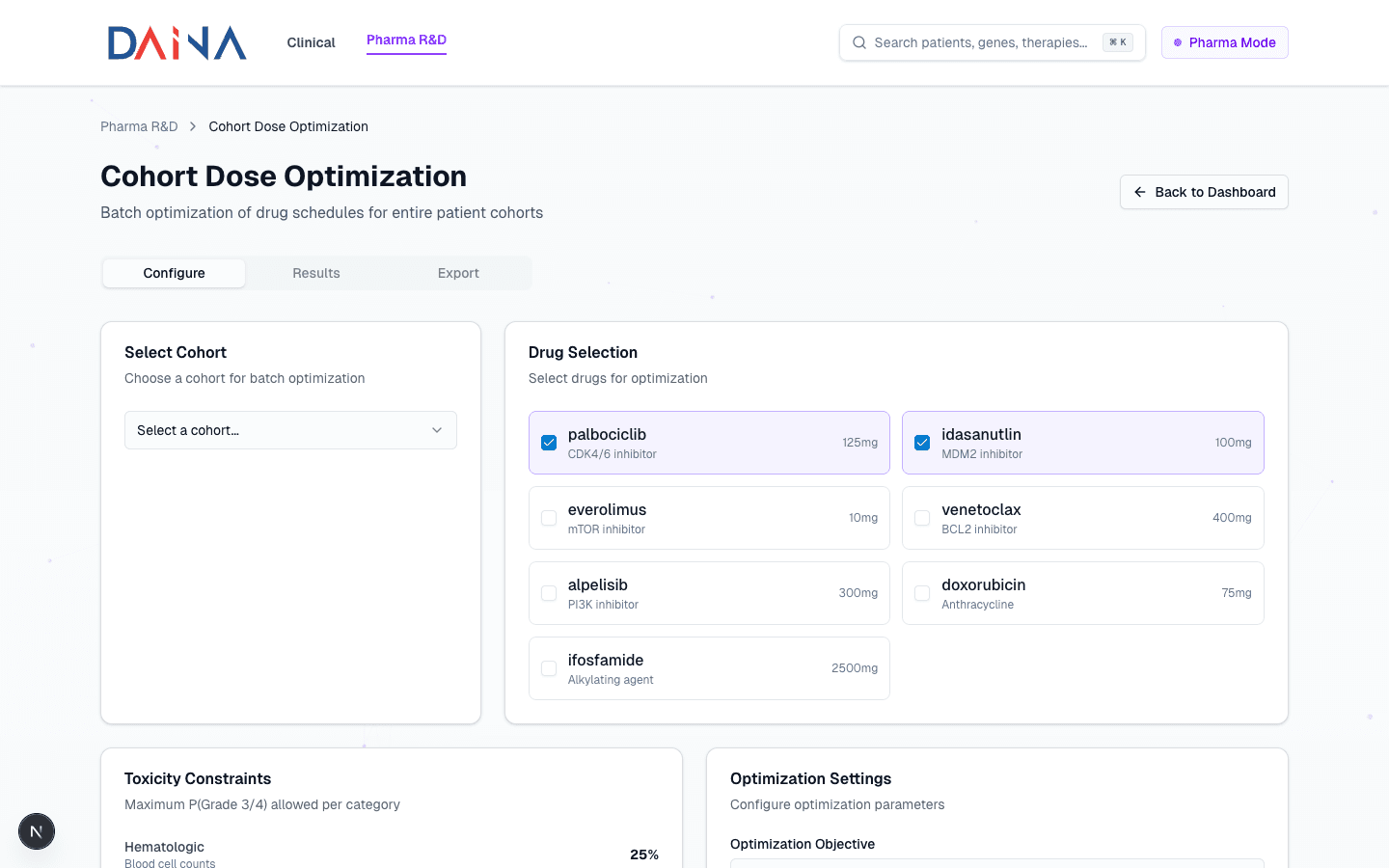
Identify patients most likely to benefit — before enrollment
Simulation suggests up to 10× enrichment in responder prevalence for select cancer types, based on retrospective analysis of observational data.
Methodology & Limitations
- •Based on retrospective analysis of TCGA observational data (N=9,393)
- •CATE estimates from S-learner model with propensity weighting — not randomized trials
- •For hypothesis generation and trial design planning, not efficacy claims
- •All enrichment results require prospective validation in controlled trials
How Simulation-Based Enrichment Works
Enrichment Potential by Cancer Type
Retrospective simulation on TCGA data (N=9,393). Enrichment = HR improvement when selecting CATE-predicted top responders.
| Cancer | N | All-Comers HR | Enriched HR | Enrichment Potential |
|---|---|---|---|---|
| LGG | 516 | 0.83 | 0.42 | Strong |
| HNSC | 521 | 0.80 | 0.52 | Strong |
| BRCA | 1091 | 0.72 | 0.61 | Moderate |
| ESCA | 184 | 0.60 | 0.25 | Strong |
| KIRC | 534 | 0.83 | 0.76 | Moderate |
| SARC | 255 | 1.31 | 1.31 | Insufficient |
Known Limitations
Intended use
DNAI is intended solely as an in silico research tool for hypothesis generation in drug development. It is not validated for regulatory submissions, clinical decision-making, or patient selection. All simulations should be interpreted alongside standard preclinical and clinical evidence.
Run your first simulation
Free retrospective pilot on your data. See translation confidence, enrichment biomarkers, and mechanism reports for your pipeline.
Contact Us