
Simulate Therapy Outcomes. Compare With Confidence.
DNAI converts multi-omics and pathology data into physics-constrained digital twins — enabling oncologists and biopharma to compare treatment scenarios with quantified uncertainty.
For Clinicians
Compare therapy options for your patient. See simulated trajectories with confidence intervals and rationale.
Explore clinical toolsFor Biopharma
Forecast trial outcomes, generate virtual control arms, and stratify cohorts — before enrollment begins.
Explore trial toolsFor Researchers
Stratify cohorts, discover biomarkers, and validate hypotheses. Interpretable simulations with structured abstention.
Explore research toolsValidated Architecture. Biologically Bounded.
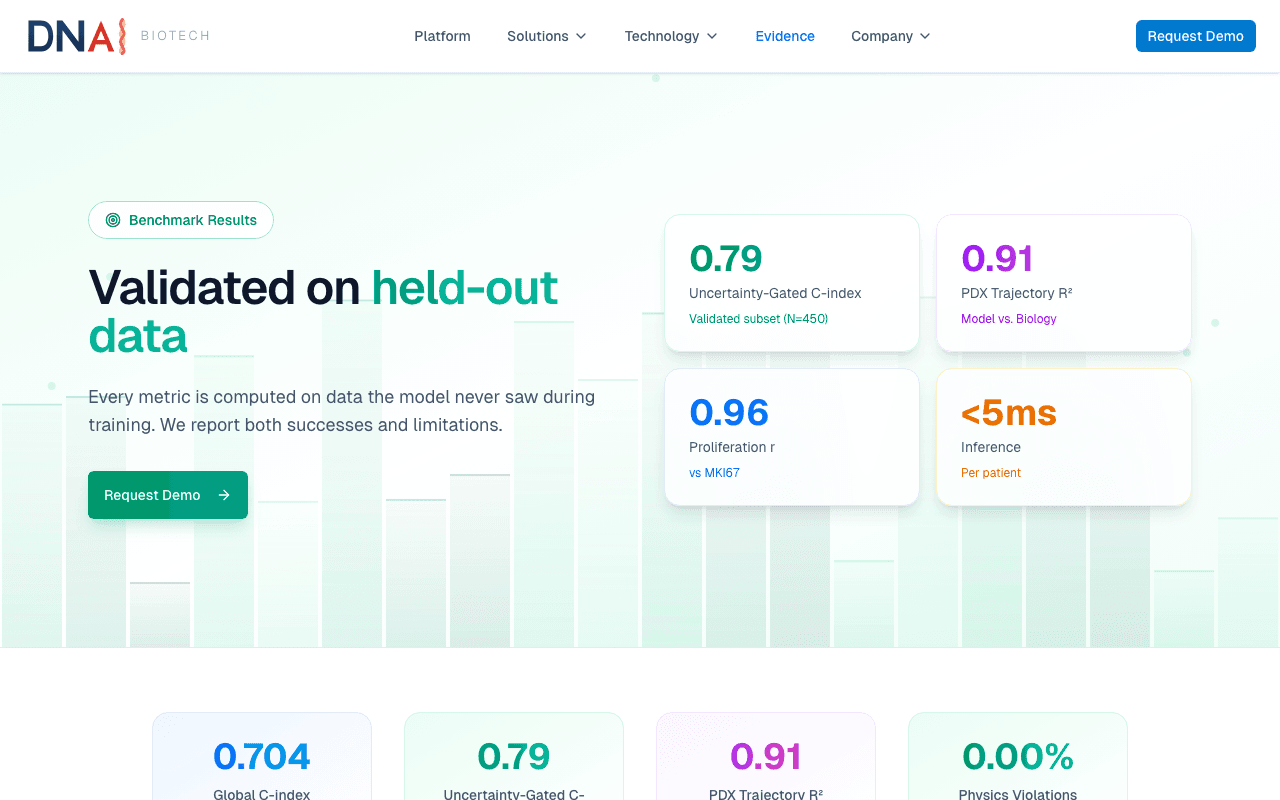
Evaluated across multiple independent cohorts. Every simulation is constrained by biological law — performance reported per cancer type and modality.
Biologically Constrained
Tumor growth rates, drug sensitivity, and immune parameters are bounded to biologically plausible ranges. Outputs that violate physical constraints are rejected.
Interpretable by Design
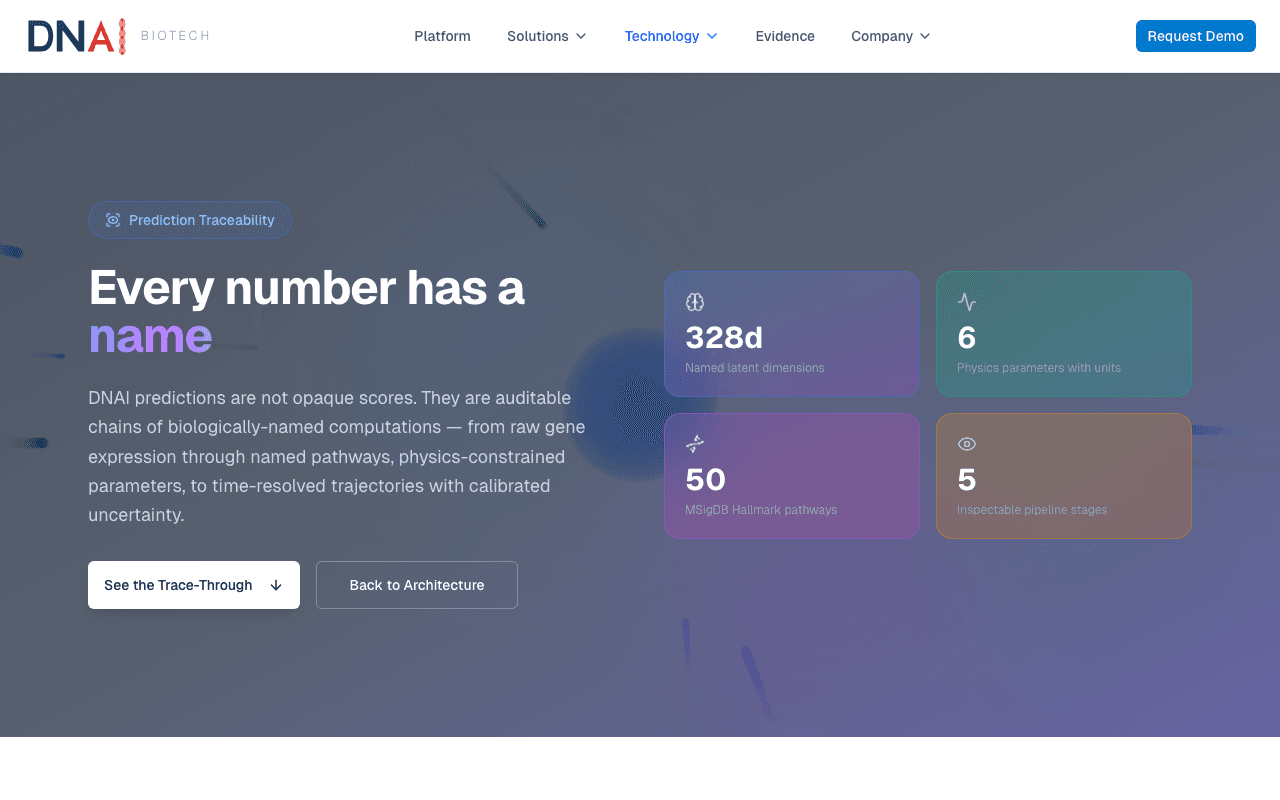
Every simulation traces to specific genes, pathways, and physics parameters. Driver gene rankings, pathway-level attributions, and uncertainty intervals — not a black-box score.
Audit-Compatible
21 CFR Part 11 audit trail, calibrated probabilities, and signed execution tokens. Designed for regulatory compatibility.
Structured Abstention
When patient data is insufficient or out-of-distribution, the system flags uncertainty and explains what is missing — rather than forcing a prediction.
How It Works
Three steps from patient data to actionable simulation.
1. Patient Data In
RNA-seq, DNA mutations, CNV, methylation, histopathology — the platform ingests what you already have. Probabilistic fusion handles missing modalities; best results with matched pathology (WSI).
2. Digital Twin Simulates
A patient-specific tumor model simulates growth, drug response, resistance timing, and immune dynamics — all constrained by biological physics.
3. Decision-Ready Output
Ranked treatment options with survival projections, confidence intervals, and the specific genes and pathways driving each simulation.
Unlike black-box AI, DNAI simulations are constrained by biological physics.
Growth rates, drug sensitivity, and immune parameters are bounded to biologically plausible ranges. If data is insufficient, the system abstains and explains what is missing — rather than guessing.
Why DNAI?
Most oncology AI predicts static risk. DNAI simulates treatment scenarios, quantifies reliability, and abstains when evidence is insufficient — backed by mechanistic constraints and external validation.
Reliability-gated, counterfactual digital twins that simulate tumor dynamics per patient
Counterfactual Treatment Simulation
Don't just predict risk — simulate the remedy. We model 6 distinct treatment scenarios for every patient to rank options by potential benefit under uncertainty.
Structured Reliability Gating
Engineered to abstain when data is insufficient. Every patient receives a High / Medium / Low reliability score based on information sufficiency — not a forced prediction.
Physics-Constrained Dynamics
Not just pattern-matching — tumor dynamics. We use differential equations with bounded biological parameters: proliferation, drug sensitivity, and immune killing. Predictions are plausible by design.
Evaluated on External Cohorts
Tested where it matters — outside the training data. Multi-site external cohorts with per-patient reliability checks, not just internal cross-validation. Performance varies by cancer type and modality.
How DNAI compares
PDX-to-Human Translation
Our patented Domain Separation Network bridges preclinical mouse models to human biology — removing species-specific stroma while preserving tumor signal. Translate PDX efficacy signals toward human endpoints for research prioritization.
Research use only. Not cleared or approved for clinical decision-making. Survival estimates based on observational counterfactual modeling.
For Clinicians
Simulation-informed treatment planning
Virtual Tumor Board
Visualize likely outcomes for Standard of Care vs. experimental agents before making treatment decisions.
Resistance Forecasting
"Alert: Subpopulation 3 projected to drive resistance to Therapy A by Day 180." Plan adaptive strategies proactively.
Dose Optimization
Explore dosing schedules that balance efficacy and safety constraints — optimized through the differentiable tumor model.
For Biopharma
In silico trials and mechanism discovery
Hybrid Control Arms
Generate physics-constrained synthetic patient trajectories for control arms. Modeled potential to reduce control-arm enrollment by 30–50% — enabling more patients to receive experimental treatments.
Mechanism Discovery
Use the Driver module to understand why a drug works in Subgroup A but fails in Subgroup B. Identify predictive biomarkers.
Rescue Failed Assets
Identify the specific dosing schedule or patient subpopulation required to make a failed compound effective.
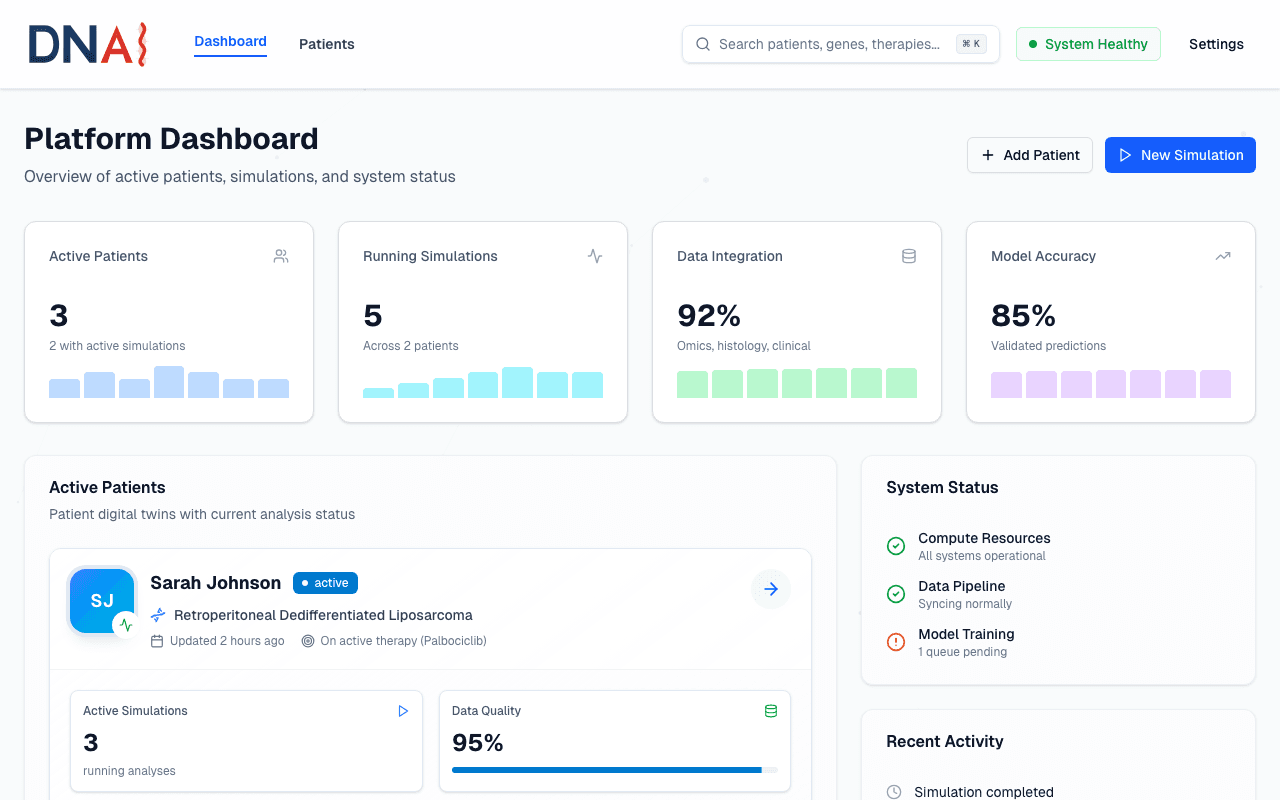
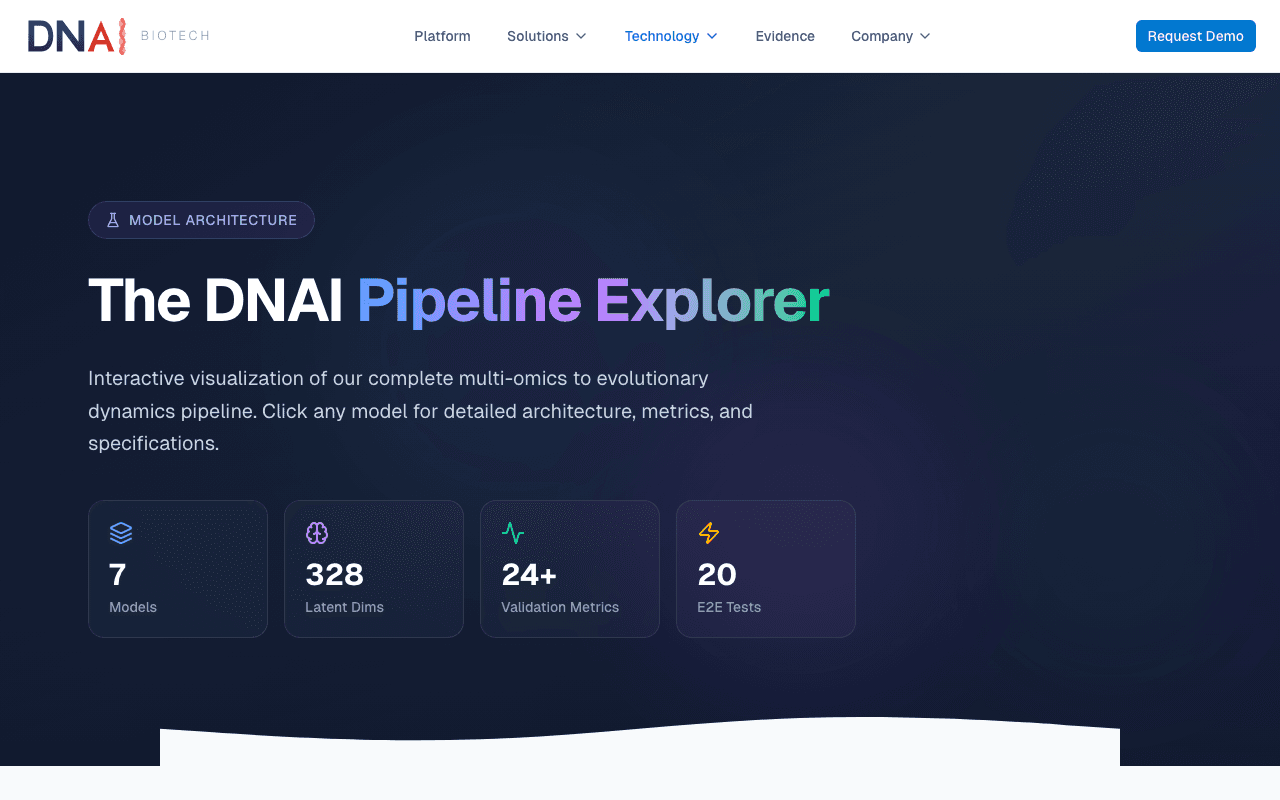
The Platform at Work
From patient dashboard to tumor evolution simulations — explore the DNAI interface.
Ready to simulate?
See how DNAI can transform your oncology workflows.